AI Regulation 2026: Congressional Committee’s 4 Key Policy Recommendations

The 2026 Congressional Committee released a comprehensive report detailing four key policy recommendations for AI regulation, significantly influencing technological governance.
The landscape of artificial intelligence is evolving at an unprecedented pace, presenting both immense opportunities and complex challenges. Staying ahead of this curve, the Congressional Committee Releases 2026 Report on AI Regulation: 4 Key Policy Recommendations, aiming to establish a robust framework for its responsible development and deployment. This report is not just a document; it’s a blueprint for navigating the future of technology.
Understanding the impetus behind the 2026 AI regulation report
The rapid advancement of artificial intelligence has made it clear that existing regulatory frameworks are often insufficient to address its unique complexities. This section delves into the foundational reasons that compelled the Congressional Committee to undertake such a comprehensive review in 2026, highlighting the urgent need for proactive governance.
As AI systems become more integrated into critical sectors like healthcare, finance, and national security, the potential for unintended consequences, ethical dilemmas, and systemic risks grows. The committee recognized that a reactive approach would be inadequate, necessitating a forward-looking strategy that anticipates future challenges while fostering innovation. This report is a testament to the belief that regulation can, and should, guide technological progress responsibly.
The evolving AI landscape
The past few years have seen generative AI, autonomous systems, and advanced machine learning models move from theoretical concepts to tangible applications. This rapid evolution has outpaced traditional legislative cycles, creating a regulatory vacuum that the 2026 report aims to fill. The committee’s work reflects a deep understanding of these technological shifts.
- Generative AI: The rise of models capable of creating realistic text, images, and audio has raised concerns about misinformation, intellectual property, and creative industries.
- Autonomous Systems: The increasing deployment of self-driving vehicles, drones, and automated decision-making systems necessitates clear liability and safety standards.
- Ethical AI: Addressing bias, fairness, transparency, and accountability in AI algorithms has become paramount to ensuring equitable outcomes for all citizens.
- Economic Impact: The potential for AI to transform labor markets, create new industries, and disrupt existing ones requires careful consideration of workforce retraining and economic adaptation.
In essence, the 2026 report is a critical step towards creating a regulatory environment that supports innovation while safeguarding public interest. It acknowledges that effective governance must be dynamic, adaptable, and informed by ongoing technological developments.
Recommendation 1: Establishing a federal AI oversight body
One of the most significant proposals within the 2026 Congressional Committee report is the establishment of a dedicated federal agency to oversee AI development and deployment. This recommendation stems from the recognition that AI’s cross-cutting nature demands a centralized, expert-driven approach, rather than fragmented regulation across various existing bodies.
The proposed agency would be tasked with a broad mandate, including setting industry standards, conducting risk assessments, and enforcing compliance. Its creation signifies a strategic shift towards a more unified and coherent regulatory landscape for artificial intelligence, ensuring that expertise is concentrated and applied consistently across sectors. This body would serve as a crucial point of contact for developers, researchers, and the public.
Rationale for a centralized authority
Historically, new technologies have often been regulated by existing agencies, each with its own specific domain. However, AI’s pervasive impact across all sectors makes this approach inefficient and potentially contradictory. A centralized body offers several distinct advantages.
- Expertise Concentration: It would house specialists in AI ethics, machine learning, data science, and law, providing a deep well of knowledge for informed decision-making.
- Standardization: The agency could develop uniform standards for AI safety, security, and transparency, reducing confusion and fostering predictable development environments.
- Interagency Coordination: It would facilitate better communication and collaboration among different government departments that are impacted by AI, ensuring a holistic regulatory view.
- Public Trust: A dedicated, transparent oversight body can help build public confidence in AI technologies by providing clear accountability and avenues for redress.
\
The committee envisages this body as a dynamic entity, capable of adapting its regulations as AI technology evolves. Its primary goal would be to balance the promotion of innovation with the imperative of protecting public welfare, fostering an environment where AI can thrive responsibly.
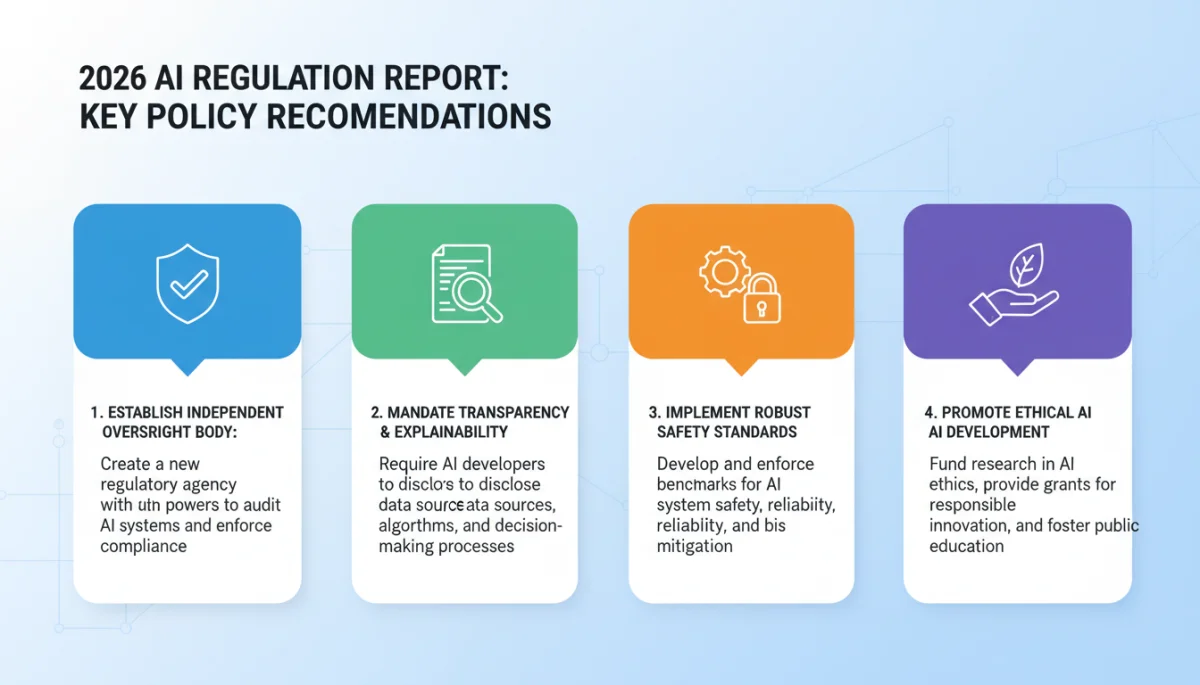
This recommendation underscores a proactive stance, moving beyond piecemeal solutions to create a robust, future-proof regulatory infrastructure. It acknowledges that the complexities of AI demand a governance model that is as sophisticated and interconnected as the technology itself.
Recommendation 2: Implementing a national AI risk assessment framework
The second key policy recommendation from the 2026 report focuses on establishing a national framework for AI risk assessment. This initiative aims to standardize how potential risks associated with AI systems are identified, evaluated, and mitigated across various applications and industries. The goal is to move beyond anecdotal risk management to a systematic, data-driven approach.
This framework would mandate that developers and deployers of AI systems conduct thorough risk assessments before, during, and after deployment. It would categorize AI systems based on their potential impact, from low-risk applications to high-stakes scenarios involving critical infrastructure or human life. This tiered approach ensures that regulatory scrutiny is proportional to the potential harm.
Components of the risk assessment framework
The proposed framework is comprehensive, designed to cover various facets of AI risk. It encourages a holistic view, considering not just technical vulnerabilities but also societal and ethical implications. This multi-dimensional assessment is crucial for effective risk mitigation.
- Bias Detection and Mitigation: Mandating checks for algorithmic bias in training data and model outputs to ensure fairness and prevent discrimination.
- Data Privacy and Security: Requiring robust measures to protect personal data used by AI systems and prevent unauthorized access or misuse.
- Transparency and Explainability: Encouraging the development of AI systems that can explain their decisions, particularly in high-impact applications, to foster trust and accountability.
- Human Oversight and Intervention: Ensuring that human operators retain ultimate control and the ability to intervene in critical AI decision-making processes.
- Societal Impact Assessment: Evaluating the broader societal implications of AI deployment, including employment displacement, ethical concerns, and potential for misuse.
By implementing such a framework, the Congressional Committee seeks to create a culture of responsibility within the AI industry. It ensures that innovation does not come at the expense of safety, fairness, or human rights, providing clear guidelines for responsible development. This framework will be instrumental in building a resilient AI ecosystem.
Recommendation 3: Investing in AI literacy and workforce retraining programs
The third major recommendation highlights the critical need for significant investment in AI literacy and workforce retraining programs across the United States. The 2026 report recognizes that the societal impact of AI extends beyond technical regulation to encompass the human element, particularly in terms of education and employment. This forward-thinking approach aims to prepare the workforce for the evolving demands of an AI-driven economy.
These programs would target various demographics, from K-12 education to adult learners and displaced workers. The goal is to equip individuals with the skills necessary to thrive in an environment where AI tools are increasingly prevalent, fostering a more adaptable and resilient labor force. The committee understands that technological progress must be accompanied by human development.
Bridging the skills gap
The rapid advancement of AI creates a growing demand for specialized skills, while simultaneously automating certain routine tasks. This dual effect necessitates a proactive strategy to ensure that the workforce remains competitive and that individuals have opportunities to transition into new roles. The proposed investment aims to address this skills gap directly.
- Curriculum Development: Supporting the creation of new educational curricula focused on AI fundamentals, data science, and ethical AI principles for all educational levels.
- Vocational Training: Funding vocational programs that train workers in AI-adjacent fields, such as AI system maintenance, data annotation, and human-AI collaboration.
- Lifelong Learning Initiatives: Promoting platforms and resources for continuous learning, enabling professionals to update their skills as AI technologies evolve.
- Public Awareness Campaigns: Educating the general public about the benefits and challenges of AI, fostering a more informed and engaged citizenry.
By investing in these programs, the Congressional Committee seeks to mitigate potential job displacement and harness AI’s potential to create new economic opportunities. This recommendation underscores a commitment to inclusive growth, ensuring that the benefits of AI are broadly shared across society. It’s about empowering people alongside technology.
Recommendation 4: Fostering international collaboration on AI governance
The fourth key policy recommendation in the 2026 report emphasizes the crucial importance of fostering international collaboration on AI governance. Artificial intelligence is a global technology, transcending national borders, and its effective regulation therefore demands a coordinated international effort. This approach acknowledges that unilateral actions are insufficient to address the worldwide implications of AI.
The report advocates for the United States to take a leading role in establishing global norms, standards, and best practices for AI development and deployment. This includes working with allies and international bodies to develop common frameworks for ethical AI, data sharing, and mitigating cross-border risks. The aim is to create a harmonized global approach that prevents regulatory arbitrage and promotes responsible AI worldwide.
The necessity of a global approach
The challenges posed by AI, such as algorithmic bias, data privacy, and the potential for autonomous weapons, are not confined to any single nation. Addressing these issues effectively requires a collective response that leverages diverse perspectives and resources. International collaboration offers several compelling benefits.
- Harmonized Standards: Developing consistent international standards for AI safety, security, and ethics can prevent a ‘race to the bottom’ where countries compete by lowering regulatory bars.
- Shared Best Practices: Facilitating the exchange of knowledge and best practices among nations can accelerate the development of effective regulatory solutions globally.
- Addressing Cross-Border Issues: Collaborating on issues like data flows, cyber security, and the use of AI in international relations is essential for global stability.
- Promoting Responsible Innovation: A unified international front can encourage the responsible development of AI by multinational corporations, ensuring adherence to ethical guidelines regardless of operational location.
This recommendation underscores a vision of AI governance that is globally interconnected and cooperative. It recognizes that the future of AI is a shared responsibility, requiring concerted efforts from nations worldwide to ensure its development benefits all humanity. This collaborative spirit is vital for long-term success.
The path ahead: implementation and adaptation
With the release of the 2026 report, the focus now shifts to the practical implementation of these four key policy recommendations. This phase will undoubtedly involve significant legislative efforts, inter-agency coordination, and continuous engagement with stakeholders from industry, academia, and civil society. The journey from recommendation to actionable policy is often complex, requiring careful navigation and a commitment to detail.
The Congressional Committee emphasizes that these recommendations are not static; they are intended to be living principles that can adapt to the fast-changing nature of AI technology. Regular reviews and updates will be crucial to ensure the regulatory framework remains relevant and effective in addressing emerging challenges and opportunities. This adaptive approach is fundamental to long-term success.
Challenges in implementation
Implementing such far-reaching policies will not be without its hurdles. Political will, resource allocation, and the need for bipartisan cooperation will all play critical roles. Furthermore, striking the right balance between robust regulation and fostering innovation will be a delicate act, requiring continuous dialogue and compromise.
- Technological Pace: Ensuring that regulatory updates keep pace with AI’s rapid advancements.
- Resource Allocation: Securing adequate funding and personnel for the new federal oversight body and training programs.
- Stakeholder Consensus: Building broad agreement among diverse groups with often conflicting interests.
- Global Cooperation: Navigating complex international relations to achieve harmonized global AI governance.
Despite these challenges, the 2026 report provides a clear and ambitious roadmap for AI governance in the United States. Its success will depend on a collective commitment to its principles and a willingness to adapt as the AI landscape continues to evolve. The future of AI, and its impact on society, hinges on these crucial next steps.
Anticipating the societal and economic impact of AI regulation
The 2026 Congressional Committee report on AI regulation is not merely a set of policy recommendations; it is a foundational document poised to significantly shape the societal and economic fabric of the United States. This section explores the anticipated long-term impacts of these proposed regulations, examining how they might redefine industries, influence workforce dynamics, and ultimately affect daily life.
By establishing clear guidelines and oversight mechanisms, the report aims to foster an environment where AI can be developed and deployed with greater confidence and ethical consideration. This stability is expected to encourage responsible investment and innovation, potentially leading to new economic sectors and more equitable technological benefits across society. The ripple effects of such comprehensive regulation will be felt for decades.
Transformative effects on key sectors
The proposed regulations are designed to have a profound impact across various industries, ensuring that AI integration is both beneficial and safe. From healthcare to finance, the committee’s recommendations offer a framework for responsible growth.
- Healthcare: Enhanced data privacy and ethical AI frameworks could accelerate the development of personalized medicine while safeguarding patient information.
- Finance: Standardized risk assessments for AI algorithms could improve fraud detection and financial modeling, increasing market stability and fairness.
- Manufacturing: Clear guidelines for autonomous systems could boost automation efficiency while ensuring worker safety and ethical deployment of robotics.
- Education: Investments in AI literacy will prepare the next generation for an AI-driven world, fostering critical thinking and technological fluency.
Economically, these regulations are anticipated to create a more predictable and trustworthy environment for AI investment, potentially attracting more capital and talent to the U.S. market. Socially, by prioritizing fairness and transparency, the policies aim to mitigate potential biases and ensure that AI serves all segments of the population equitably. The report is a catalyst for a more just and technologically advanced future.
| Key Recommendation | Brief Description |
|---|---|
| Federal AI Oversight Body | Establish a centralized agency for AI standards, risk assessment, and enforcement. |
| National AI Risk Framework | Standardize identification, evaluation, and mitigation of AI risks across sectors. |
| AI Literacy & Workforce Retraining | Invest in education and training programs to prepare the workforce for an AI economy. |
| International AI Collaboration | Foster global partnerships to establish common norms and standards for AI governance. |
Frequently asked questions about AI regulation
The main objective of the 2026 report is to establish a comprehensive and adaptive regulatory framework for artificial intelligence in the United States, balancing innovation with ethical development and public safety. It aims to proactively address the challenges posed by rapidly advancing AI technologies.
A federal AI oversight body will centralize expertise, standardize regulations across sectors, improve interagency coordination, and build public trust. This will create a more predictable and coherent regulatory environment, fostering responsible innovation and reducing fragmented approaches to AI governance.
The framework addresses various risks, including algorithmic bias, data privacy and security, lack of transparency, insufficient human oversight, and broader societal impacts. It categorizes AI systems by potential harm to ensure proportional regulatory scrutiny, safeguarding fairness and accountability in AI deployment.
Workforce retraining is crucial to bridge the skills gap created by AI advancements, prepare individuals for new roles, and mitigate potential job displacement. It ensures that the benefits of AI are shared broadly by enabling a more adaptable and resilient labor force capable of thriving in an evolving economy.
International collaboration is vital because AI is a global technology. It helps establish harmonized standards, share best practices, address cross-border challenges like data flow and cyber security, and prevent regulatory arbitrage. This ensures a unified, responsible approach to AI development worldwide.
Conclusion
The 2026 Congressional Committee report on AI regulation marks a pivotal moment in the governance of artificial intelligence. Its four key policy recommendations—establishing a federal oversight body, implementing a national risk assessment framework, investing in AI literacy and workforce retraining, and fostering international collaboration—provide a comprehensive and forward-thinking blueprint. This report underscores a clear commitment to harnessing the transformative power of AI responsibly, ensuring that its development and deployment serve the public good while fostering innovation. The path ahead requires continued diligence, adaptability, and collaboration, but with this foundational report, the United States is well-positioned to navigate the complex future of AI.