Leveraging Commuter Benefits: Save up to $315 Monthly in 2025

Commuter benefits allow employees to save significantly on transportation costs by using pre-tax deductions for eligible expenses, potentially reducing monthly out-of-pocket spending by up to $315 in 2025, offering a smart financial strategy.
Are you looking for a smart way to boost your take-home pay and reduce your commuting costs? In 2025, Leveraging Commuter Benefits: Save up to $315 per Month in 2025 with Pre-Tax Deductions isn’t just a possibility; it’s a financial strategy that savvy employees are embracing. Understanding and utilizing these benefits can significantly impact your personal budget.
Understanding commuter benefits: The fundamentals
Commuter benefits programs are designed to help employees save money on their daily commute to work. These programs allow you to set aside pre-tax dollars from your paycheck to cover qualified transportation expenses. It’s a win-win situation: you save on taxes, and your employer often benefits from reduced payroll taxes.
The core idea behind commuter benefits is simple: instead of paying for your commute with after-tax dollars, you use money that hasn’t yet been subjected to federal, state, or FICA taxes. This effectively lowers your taxable income, leading to a higher net take-home pay. For many, this translates into substantial savings over the course of a year, making a noticeable difference in their personal finances.
What qualifies as an eligible expense?
Not all transportation expenses are covered under commuter benefits. The IRS defines specific categories that qualify for pre-tax deductions. Knowing these categories is crucial for maximizing your savings.
- Mass Transit: This includes fares for buses, subways, trains, and ferries. If you rely on public transportation, this is a primary area for savings.
- Vanpooling: Costs associated with vanpooling, where a vehicle carries at least six adults (excluding the driver) and at least 80% of the mileage is for commuting purposes, are eligible.
- Qualified Parking: Expenses for parking at or near your workplace, or at a location from which you commute via mass transit or vanpool, are also covered. This does not include parking at or near your home.
The rules are set by the IRS, and they are updated periodically. Staying informed about these changes is key to fully leveraging your benefits. For 2025, the maximum monthly pre-tax deduction for transit and vanpool expenses, as well as for qualified parking, is projected to be $315. This represents a significant opportunity for individuals to manage their commuting costs more efficiently.
In essence, commuter benefits offer a tangible way to reduce your financial burden related to getting to and from work. By understanding the eligible expenses and how the program works, you can effectively lower your taxable income and keep more of your hard-earned money.
The mechanics of pre-tax deductions for commuting
Pre-tax deductions are a powerful tool for financial planning, and their application to commuting expenses is no exception. When you enroll in a commuter benefits program, you elect to have a certain amount deducted from your gross pay before taxes are calculated. This reduces your taxable income, leading to immediate savings on federal income tax, state income tax (in most states), and FICA taxes (Social Security and Medicare).
The process is typically managed through your employer, who partners with a third-party administrator. You decide how much to contribute each month, up to the IRS-mandated limits, and these funds are then loaded onto a special debit card or used to purchase vouchers. This direct integration into your payroll system makes it a seamless and convenient way to save.
How pre-tax means more take-home pay
The concept of pre-tax deductions can sometimes feel abstract, but its impact on your take-home pay is very real. Imagine you earn $3,000 per month and contribute $315 to your commuter benefits. Your taxable income is then calculated on $2,685, not $3,000. Depending on your tax bracket, this can result in substantial savings.
For example, if you’re in the 22% federal income tax bracket, you save $69.30 on federal taxes ($315 x 0.22). Add to that state income tax savings (if applicable) and FICA tax savings (7.65% for employees), and your total monthly savings can quickly add up. This money, otherwise lost to taxes, remains in your pocket to be used for other financial goals.
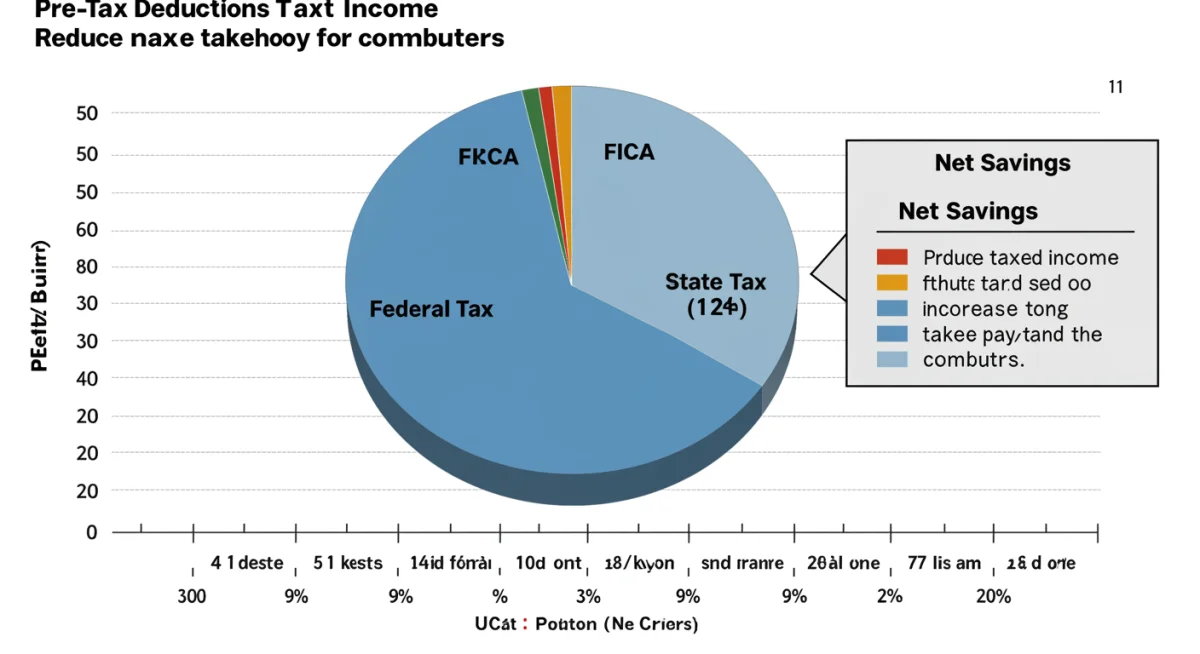
The key benefit here is not just reducing the cost of your commute, but doing so in a tax-advantaged way. This makes commuter benefits a highly efficient financial tool, especially for those who spend a considerable amount on transportation. It’s akin to getting a discount on your commute that’s subsidized by the tax system.
Understanding the mechanics of pre-tax deductions for commuting is the first step towards effectively utilizing these benefits. It’s about recognizing that every dollar you contribute to these programs is a dollar that avoids taxation, ultimately leading to greater financial flexibility and savings.
Projected savings for 2025: Up to $315 monthly
The year 2025 brings with it a projected maximum pre-tax deduction of $315 per month for qualified commuter expenses. This figure, set by the IRS, is a crucial benchmark for anyone looking to maximize their savings. For many, this monthly allowance can translate into significant annual savings, making a tangible difference in their financial outlook.
To put this into perspective, if you consistently contribute the maximum $315 each month, you could save up to $3,780 annually on pre-tax commuting expenses. The actual cash savings will depend on your individual tax bracket, but even at a conservative estimate, the financial impact is considerable. This makes commuter benefits one of the most underrated employee perks available.
Calculating your individual savings potential
While the $315 maximum is a universal figure, your personal savings will vary based on several factors. It’s important to do a quick calculation to understand your specific benefit. Consider your marginal tax rate, which includes federal, state, and local income taxes, as well as FICA contributions.
- Federal Tax: Identify your federal income tax bracket.
- State Tax: If your state has an income tax, factor that in.
- FICA Tax: This is a fixed 7.65% for employees on earnings up to a certain limit.
Let’s say your combined marginal tax rate (federal, state, FICA) is 30%. Contributing $315 pre-tax would save you $94.50 each month ($315 x 0.30). Over a year, that’s $1,134 in your pocket simply by utilizing a benefit you might already be eligible for. This calculation underscores the importance of actively participating in your employer’s commuter benefits program.
The projected $315 monthly limit for 2025 provides a clear target for employees aiming to optimize their commuting costs. By understanding how these deductions work and calculating your personal savings potential, you can effectively leverage this benefit to improve your financial health throughout the year.
Who is eligible for commuter benefits?
Eligibility for commuter benefits largely depends on your employment status and your employer’s offerings. Typically, any employee who commutes to work using qualified transportation methods is eligible. This includes full-time, part-time, and even seasonal employees. However, self-employed individuals are generally not eligible to participate in these pre-tax programs, as they do not have an employer to administer the deductions.
The crucial factor is that your employer must offer a commuter benefits program. While many companies, especially larger ones, do provide this option, it’s not a federally mandated benefit. Therefore, checking with your HR department or benefits administrator is the first step to confirm your eligibility and understand the specifics of your company’s program.
Employer requirements and program types
For an employer to offer commuter benefits, they typically partner with a third-party administrator. These administrators handle the complexities of compliance with IRS regulations, fund management, and distribution of benefits to employees. Employers also benefit from offering these programs, as they can save on payroll taxes (FICA and FUTA) because the pre-tax contributions reduce their total payroll.
There are generally two main types of commuter benefit programs:
- Employer-sponsored programs: These are the most common, where your employer sets up and manages the program, often through a benefits provider.
- Direct employee election: In some cases, employees might have options to enroll directly with a benefits administrator if their employer does not offer a specific program, though this is less common for pre-tax deductions.
It’s important to note that while the IRS sets the maximum limits, employers can choose to offer lower limits or cover only specific types of commuting expenses. Therefore, always review your company’s specific plan details to ensure you are fully aware of what is covered and what your maximum contribution can be. Confirming your eligibility and understanding your employer’s program are essential steps toward unlocking these valuable savings.
How to enroll and maximize your commuter benefits
Enrolling in your employer’s commuter benefits program is usually a straightforward process, but taking the right steps can ensure you maximize your savings. The first step involves contacting your HR department or benefits administrator to inquire about the program and obtain enrollment forms or access to their online portal.
Once you have the necessary information, you’ll typically need to decide on your monthly contribution amount. This is where strategic planning comes into play. To maximize your benefits, you should aim to contribute an amount that closely matches your actual monthly commuting expenses, up to the IRS limit of $315 for 2025. Over-contributing can lead to funds being tied up, while under-contributing means you’re missing out on potential tax savings.
Tips for optimizing your contributions
To truly get the most out of your commuter benefits, consider these practical tips:
- Track Your Expenses: Keep a record of your monthly commuting costs for a few months. This includes public transit fares, vanpool fees, and parking costs. This data will help you set an accurate contribution amount.
- Adjust as Needed: Your commuting habits might change. If you start carpooling more often, switch to a different mode of transport, or move closer to work, adjust your contributions accordingly. Most programs allow you to modify your election periodically.
- Understand Rollover Policies: Some programs allow unused funds to roll over to the next month or year, while others might have a “use it or lose it” policy. Knowing this will help you plan your contributions more effectively.
Remember, the goal is to fully utilize the pre-tax advantage without accumulating excessive unused funds. By carefully planning and regularly reviewing your contributions, you can ensure that you are consistently leveraging commuter benefits to their fullest extent. This proactive approach will help you save the maximum amount possible on your daily travel to work.
Common questions and misconceptions
Despite the clear advantages of commuter benefits, several questions and misconceptions often arise. One common query is whether these benefits are portable if you change jobs. Generally, commuter benefits are tied to your employer’s program, meaning they are not directly transferable. Unused funds might be lost or subject to specific rules upon termination, so it’s vital to understand your plan’s policy on this.
Another misconception is that commuter benefits are only for those who use public transportation. While mass transit is a significant component, qualified parking and vanpooling expenses are also eligible. This broadens the scope of who can benefit, including those who drive to park-and-ride lots or participate in company-sponsored vanpools.
Distinguishing commuter benefits from other pre-tax accounts
It’s easy to confuse commuter benefits with other pre-tax accounts like Flexible Spending Accounts (FSAs) or Health Savings Accounts (HSAs). While all offer tax advantages, their purposes and rules differ significantly.
- FSAs (Flexible Spending Accounts): Primarily for healthcare and dependent care expenses. They typically have a “use it or lose it” rule at the end of the plan year.
- HSAs (Health Savings Accounts): For healthcare expenses, but they are paired with high-deductible health plans and offer more flexibility, including funds rolling over year to year and being invested.
- Commuter Benefits: Specifically for qualified transportation expenses. While some funds may roll over, they are distinct from health-related accounts.
The key distinction lies in their designated use and specific IRS regulations. Commuter benefits are exclusively for work-related transportation, offering a dedicated path to savings in this area. Understanding these differences helps in managing your various pre-tax accounts effectively.
Addressing these common questions and clarifying misconceptions is essential for employees to confidently enroll in and utilize their commuter benefits. By being well-informed, you can avoid potential pitfalls and fully capitalize on the financial advantages these programs offer for your daily commute in 2025.
The broader impact: Environmental and personal benefits
Beyond the immediate financial savings, leveraging commuter benefits offers a range of broader impacts, both for the individual and for the environment. Encouraging the use of public transportation and vanpooling through these benefits contributes significantly to reducing traffic congestion and lowering carbon emissions, fostering a more sustainable urban environment.
For individuals, these programs can also lead to a less stressful and more productive commute. Opting for public transit or a vanpool often means avoiding the frustrations of driving in heavy traffic, searching for parking, and dealing with the wear and tear on a personal vehicle. This can free up time for reading, working, or simply relaxing, turning commute time into a more valuable part of the day.
Promoting sustainable commuting habits
Commuter benefits play a vital role in promoting sustainable commuting habits. By making public transit and shared rides more affordable, they incentivize employees to choose environmentally friendlier options over single-occupancy vehicle use. This aligns with broader corporate social responsibility goals and urban planning initiatives aimed at creating greener cities.
- Reduced Carbon Footprint: Fewer cars on the road directly translate to lower greenhouse gas emissions.
- Less Traffic Congestion: Increased use of public and shared transport eases traffic flow, benefiting everyone.
- Improved Air Quality: A reduction in vehicle emissions leads to cleaner air in urban areas.
These environmental advantages reinforce the value of commuter benefits as more than just a financial perk. They are a tool for fostering positive societal change. Employers who offer these benefits not only support their employees’ financial well-being but also demonstrate a commitment to environmental stewardship.
Ultimately, the impact of leveraging commuter benefits extends far beyond individual wallets. It contributes to healthier communities, a cleaner planet, and a more efficient transportation system. Understanding these broader benefits adds another layer of appreciation for these valuable programs.
| Key Aspect | Description |
|---|---|
| Pre-Tax Deductions | Funds are deducted from gross pay before taxes, reducing taxable income for federal, state, and FICA taxes. |
| Monthly Savings (2025) | Up to $315 per month can be saved on eligible commuting expenses, significantly boosting take-home pay. |
| Eligible Expenses | Includes mass transit (bus, subway, train), vanpooling, and qualified parking expenses. |
| Enrollment | Typically managed through employer’s HR department or a third-party benefits administrator. |
Frequently asked questions about commuter benefits
For 2025, the projected maximum pre-tax deduction for qualified commuter expenses, including transit and vanpool costs, as well as qualified parking, is $315 per month. This limit allows employees to set aside a significant amount of money tax-free for their daily commute.
No, commuter benefits are not exclusively for public transportation users. While mass transit is a major component, the benefits also cover qualified parking expenses and costs associated with vanpooling. This means a broader range of commuters can take advantage of these tax-saving opportunities.
Pre-tax deductions save you money by reducing your taxable income. When you contribute to a commuter benefits program, that money is taken out of your paycheck before federal, state, and FICA taxes are calculated. This lowers your overall tax liability, effectively increasing your net take-home pay.
Yes, in most commuter benefit programs, you can typically change your contribution amount. This flexibility allows you to adjust your deductions if your commuting habits or expenses change. It’s advisable to check with your employer’s HR department or benefits administrator for specific policies on making such adjustments.
The treatment of unused commuter benefit funds upon job termination varies depending on your employer’s specific plan. Some plans may allow you to use the funds for a certain period after leaving, while others might have a “use it or lose it” policy. Always consult your plan administrator for details regarding fund portability and expiration.
Conclusion
In conclusion, Leveraging Commuter Benefits: Save up to $315 per Month in 2025 with Pre-Tax Deductions represents a significant financial advantage for employees across the United States. By strategically utilizing these programs, individuals can substantially reduce their taxable income and, consequently, their overall commuting costs. The projected $315 monthly limit for 2025 underscores the growing opportunity for savings, making it an essential component of smart personal finance. Beyond the individual financial gains, embracing commuter benefits also contributes to broader environmental sustainability and reduced urban congestion. Therefore, understanding, enrolling in, and actively managing these benefits is a savvy move for any commuter looking to optimize their finances and contribute to a more sustainable future.